“Twin Peaks” premiered in April 1990. It was the spring of my junior year in high school. I was growing up in a small Midwestern town as a high strung, overly dramatic ball of anxiety, hormones, self-consciousness and insecurity. I knew that I was on the cusp of jumping off into the deep, cold water of my young adulthood, but I didn’t know that I would choose some hard paths for myself over the next several formative years. I would go to a big university that I was completely unprepared for; I would struggle with depression and anxiety for the next two decades; I would live through bad experiences and toxic, exploitative relationships. All of those things waited out along that dark highway for me as I curled up breathing in the safe space of my childhood home. I alternately chafed against its cornfield boundaries and craved them, increasingly mad with boredom and yet terrified of what was next. I did not know in my own heart what I would do, if made to choose between being called to my own lesser version of the hero’s journey, or marrying the high school quarterback and living in those safe neighborhoods for the rest of my life.
I already loved David Lynch. My dad took us to Meridian Mall to see his “Dune” (we were probably too young, but we ate it up). I fell madly in love with Kyle McLachlan’s Paul and immediately spent my pocket money on Frank Herbert’s books and a “Making of Dune” companion book. (That series also became a lifelong companion for me.)
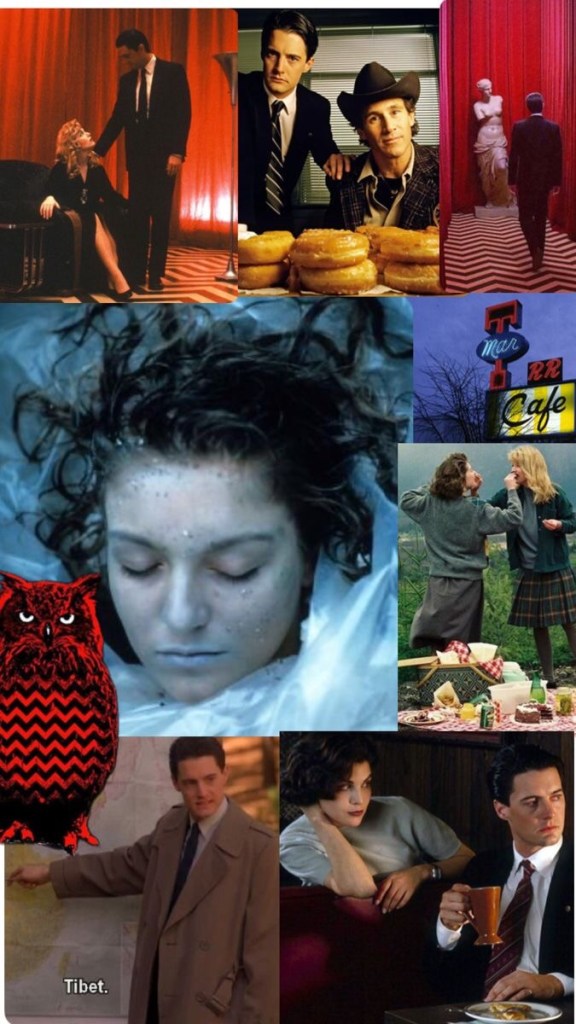
I had never seen anything like “Twin Peaks”, shot through, as it was, with wide ribbons of gentle absurdity, eccentric comedy, innocence, tenderness, beauty and the darkest vein of evil and violence. That flavor was addictive. It showed me that the boundaries of my small town may not just exist to keep people out, but to provide a terrarium that allowed certain things to root and flesh and flourish. It is a series that I have revisited dozens of times.
A couple of years later, my brother and I would see “Fire Walk with Me” in Frandor and the darkness took over the flavor. I think it’s a necessary part of the “Twin Peaks” tale but it is still very difficult for me to watch. I have mixed feelings about many of Lynch’s other works (“Mulholland Drive” being one of my other favorites – but I found his 2017 “Return” to Twin Peaks incomprehensible). I read his book on meditation and while I am not a TM adherent, meditation is still an almost-daily practice for me.
In his book, he associates meditation with catching the big fish; sending a line into the unknowable water and coming back up with something magical. I believe that David Lynch had a conduit to his own subconscious and was able, at deeper and more profound levels, to dredge the silt of our own collective unconscious at the bottom of that water and bring images, visions, concepts back to the surface, into the sunlight. Some of them, blinking in the harsh light, were grotesque and horrifying. Others shed silver water from their scales and breathed with an almost unbearable beauty. I know that David Lynch is in the white lodge now. He was the dreamer and his dreams set a match to some of my own. I will forever love and be terrified by the way he saw the world and grateful that he was able to share his visions (and reflect our own visions back to us) for a time.

 Six Ten