My mom got me a subscription to Midwest Living, and in a recent issue, they had a great article about folk schools. It was lovely and I found myself thinking, ‘wow, if there was something like that around here, I would really want to take advantage of it!’ I didn’t have to feel envious and left-out for long; as soon as I got to the index, I saw the Michigan Folk School is located a bit north of Ann Arbor, where I work. And as if that wasn’t enough of an enticement, it’s part of a historic farmstead that I drive past almost every day on my commute.
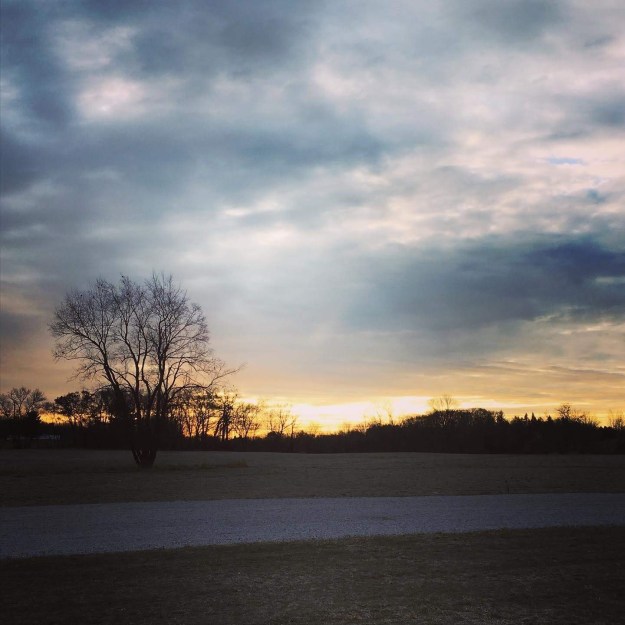
From the article – “Recharge Your Spirit at a Midwest Folk School” – “Folk schools emerged in 19th-century Denmark. These grassroots schools channeled life skills, cultural identity and the natural world to dignify rural life and farmers. Scandinavian heritage still anchors many Midwest folk schools, with daylong and weekend workshops on rosemaling, woodworking, metalsmithing or fiber arts.”
The Michigan Folk School is located at the Staebler family farm on Plymouth Road in Washtenaw County. This is or was a working farm with a 140-year old farmhouse, and the Folk School is currently developing additional facilities to support their extensive dreams and plans. Right now, you park in a somewhat lonely carpark and trudge along a curving path to the small set of buildings – barn, outbuildings, and house – and you wonder if you’re in the right place until you push open the door to a warm, friendly and bustling workspace.
Yesterday, when I arrived for my basic cold-process soap workshop, I was joined by twelve or so other people, and more came in from the cold to come walk through to the adjoining blacksmith workshop. Soon, my class introduced ourselves to the faint accompaniment of clanging iron and the smell of coal smoke. Most of us were folks who had an interest in soap making but were scared of working with lye; most of us were folks who loved a return to the old traditional ways, the handmade and homemade, and wanted to be more self-sufficient, do more with our hands, and preserve arts that are quickly becoming obsolete. And most of us wanted to make our own soaps to reduce packaging, be environmentally friendly, and lessen our contact with synthetics, perfumes, dyes and chemicals.
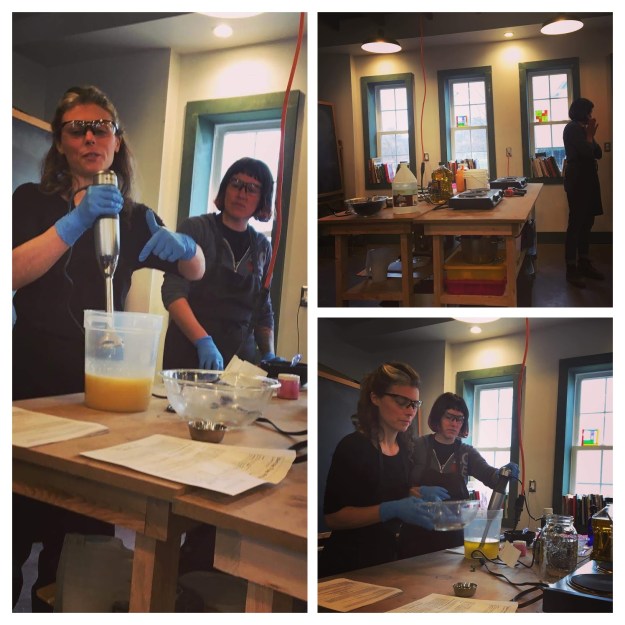
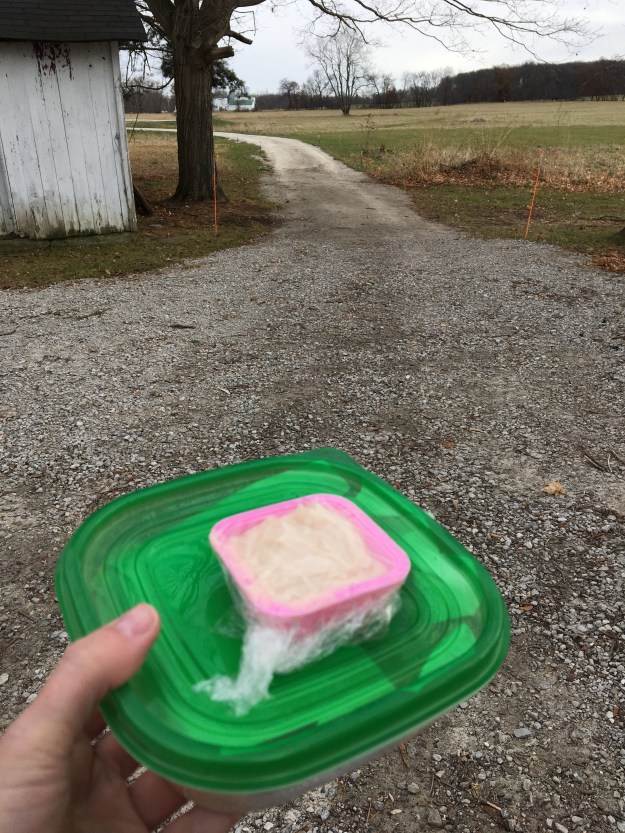
We were split up into table groups of three or four and I found myself joined up with two great women who work together in the operating room at the University of Michigan hospital – I suspect they are doctors but I did not ask. We were too busy measuring, pouring, agreeing on an essential oil for our shared soap batch (lemongrass). We worked together really well, seamlessly sharing the tasks of pouring and mixing the lye and the oils, and using infrared thermometers to check our temperatures. The three hours flew by and before I knew it, I was walking back along the rutted, frozen path holding two containers of handmade soap that I can cut tomorrow and then cure for 4-6 weeks.
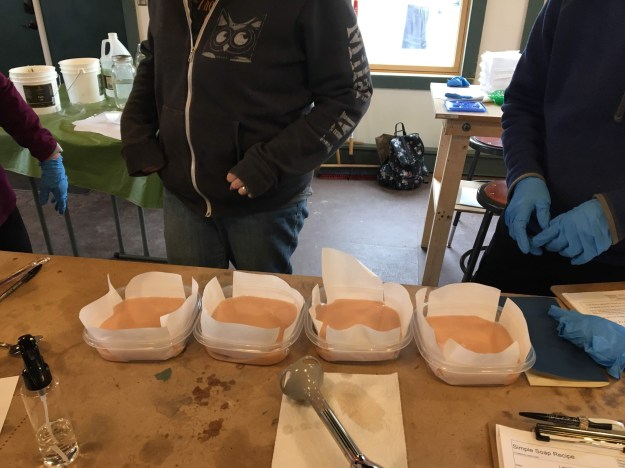
The staff at the Folk School were so friendly and passionate about their place, and everyone that I met felt immediately like a friend. I can’t wait to test my soap, and the class made me very comfortable with learning more about soap making on my own. I plan on collecting a few bits and bobs of equipment and trying my own batch after the holidays. And I loved the Folk School so much that I plan to go back for more classes – Healing Balms, Salves, and Creams in January and maybe after that, stained glass or sourdough bread (a long-dormant passion of mine).
 Six Ten